
A four-day workweek proposal lands best when it’s positioned as a performance upgrade—not a feel-good perk. Leaders want proof that output, coverage, and quality won’t slip. The good news: AI can help turn scattered notes, work logs, and stakeholder concerns into a credible, data-backed plan with clear success criteria, tight risk controls, and weekly reporting. For more guidance, see Workplace Flexibility: Promising Research Supports a 4- ….
Before debating schedules, a strong proposal answers the questions executives, HR, and operations will ask automatically: “What happens to results, service levels, and risk?” Build your pitch around five proof points. For further reading, see Pruning the Workweek.
Define 3–7 outcomes that matter for your team and your org: cycle time, tickets closed, revenue coverage, customer satisfaction, defect rate, or project milestones. State thresholds up front (for example, “cycle time must not increase by more than 5%”).
Document exactly how time-sensitive work will be handled: handoffs, on-call rotations, escalation paths, and peak-hour staffing. A four-day workweek fails fast when “coverage” is assumed instead of engineered.
List non-negotiables such as regulatory hour requirements, client SLAs, shift minimums, or time zone coverage. If a true reduction isn’t possible, propose a compliant alternative (like staggered days off or compressed schedules).
Explain eligibility by workflow constraints, not “who deserves it.” When certain roles can’t participate, offer parallel flexibility options (shift swaps, predictable scheduling, or additional PTO in lieu).
Ask for a time-boxed pilot with clear success criteria, a reporting cadence, and a pre-agreed decision date. This lowers perceived risk and makes approval easier.
AI is most useful when it improves clarity and decision quality—not when it “manufactures” confidence. Use it to organize reality, surface tradeoffs, and stress-test your plan.
Feed AI a month of calendars, meeting notes, and project updates (redacted as needed) and ask for themes: recurring meetings that don’t drive decisions, bottlenecks in approvals, common causes of rework, and delays caused by cross-team dependencies.
AI can help estimate avoidable time costs—context switching, duplicated approvals, status meetings—then tie each to a countermeasure (meeting caps, async updates, clearer decision owners, WIP limits).
One-size proposals slow down approvals. Use AI to generate: a one-page executive memo, a detailed pilot plan, and short briefs tailored to HR, finance, and operations.
Ask AI to play “skeptical COO” and produce objections about customer impact, burnout, or coordination overhead. Then refine your mitigation plan until your answers are operationally specific.
Pair leading indicators (response times, WIP, backlog health) with lagging indicators (quality, retention, revenue coverage). Keep the scorecard simple enough to run weekly.
For research context you can cite externally, see 4 Day Week Global’s research and Microsoft Japan’s reported outcomes.
Leaders move faster when the pilot is bounded, reversible, and operationally safe.
| Model | Best for | Watch-outs |
|---|---|---|
| Staggered days off (Mon–Fri coverage) | Customer-facing teams that need daily coverage | Requires clear handoffs and shared ownership to avoid bottlenecks |
| Fixed team day off (e.g., Fridays) | Project teams with fewer external dependencies | May create service gaps; plan for emergencies and end-of-week deadlines |
| Compressed hours (4×10) | Roles that must keep total hours stable | Can increase fatigue; protect breaks and avoid late-day high-stakes work |
| Reduced hours (true reduction) | Knowledge work where meeting load can be cut | Requires ruthless prioritization and tighter scope control |
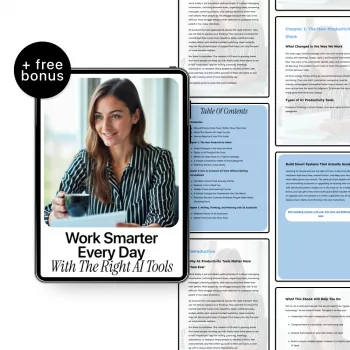
If you want to move from “idea” to a manager-ready proposal faster, a structured kit helps. The Pitch Less Hours Deliver More Impact: The Ultimate AI for Proposing a Four-Day Workweek eBook Guide to Work Smarter, Not Longer is built for team leads, ICs preparing an internal pitch, and managers who want a controlled experiment instead of a blanket policy change.
For practical energy management during a pilot (especially if you’re testing compressed hours), small routines matter. Some teams pair schedule changes with recovery habits, whether that’s post-work decompression or minimizing friction at home—like quick meal prep on a Reversible Pre-Seasoned Cast Iron Griddle with Non-Stick Surface for BBQ and Cooking, or short resets between deep-work blocks using an Ice Roller for Face & Eyes – Skin Tightening Facial Massage Tool.
No. Compressed hours typically means 40 hours packed into four days (4×10), while a true four-day workweek reduces total hours; many pilots start with staggered coverage or compressed schedules depending on constraints.
Use outcome metrics (cycle time, quality, revenue coverage), service metrics (response time, backlog health), and people metrics (engagement, retention), with clear thresholds and a weekly review cadence.
Use AI to structure the memo, summarize internal notes, and scenario-test risks, but don’t fabricate numbers. Validate every metric with internal sources, and keep assumptions explicit so leaders can audit your logic.












Leave a comment