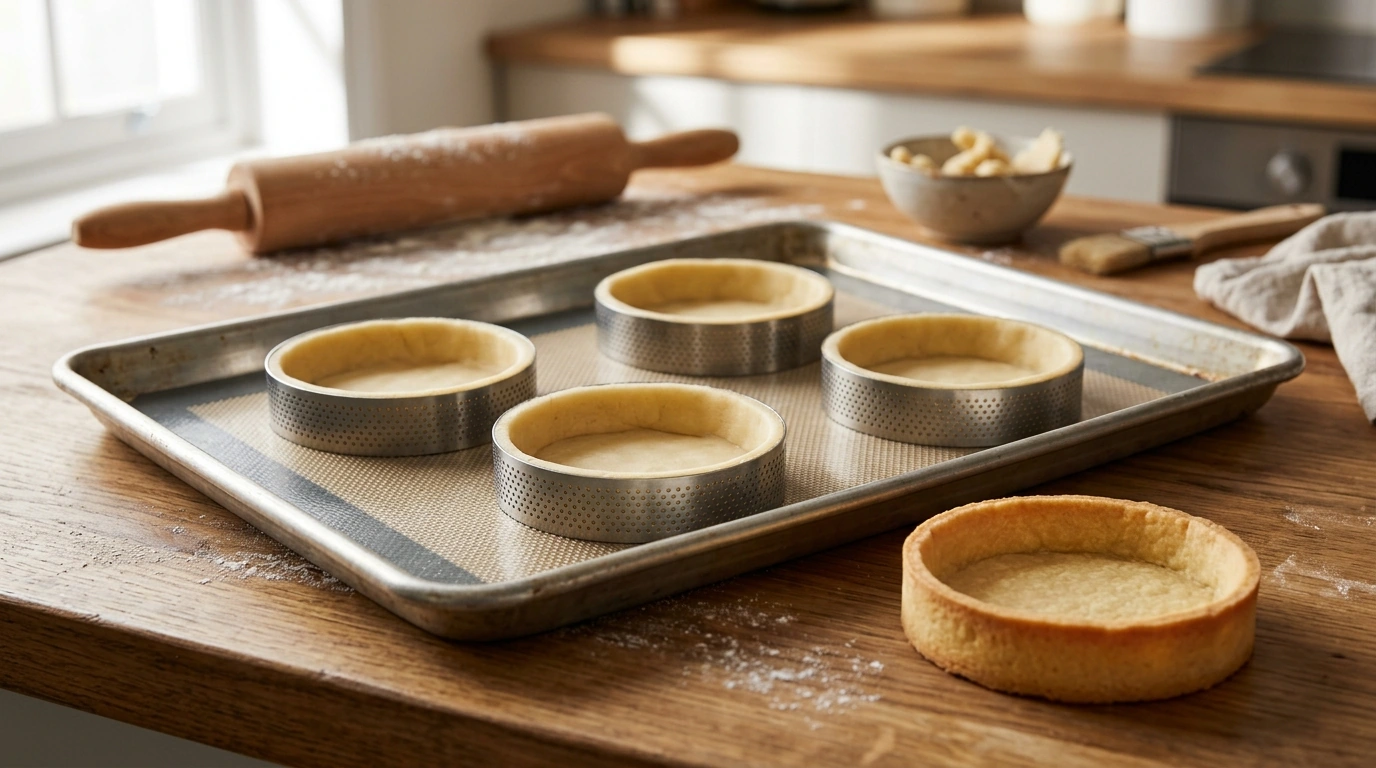
Perforated tart rings are designed to help pastry bake evenly, release cleanly, and hold sharp edges—especially for shortcrust, pâte sucrée, and sablé shells. This heat-resistant 304 stainless steel tart ring mold supports consistent airflow around the dough, helping reduce soggy bottoms and encouraging uniform browning for bakery-style results at home. For more guidance, see ERIC – ED 226 196.
A tart ring is simple in shape, but the perforations change how heat and moisture move through your crust. Instead of trapping steam against solid walls, the ring vents it—so the dough can set with a drier, crisper finish and cleaner lines. For further reading, see Download.
| Feature | Perforated Tart Ring | Traditional Tart Pan |
|---|---|---|
| Airflow | High—holes vent steam and encourage even baking | Lower—solid sides can trap moisture |
| Edge definition | Very sharp, straight sides | Often fluted; edges can soften if dough shrinks |
| Release | Lifts away once cooled; no fixed base | Depends on removable bottom; can stick at corners |
| Best use cases | Shortcrust shells, pastry display tarts, entremets bases | Everyday fruit tarts, custard tarts, pies (depending on depth) |
| Learning curve | Moderate—needs sheet pan + lining and attention to dough height | Low—fill and bake in the pan |
Material choice affects consistency. A thin, flexible ring can distort during handling, while a rigid steel ring stays true—so the same dough and bake time produces the same shape again and again.
For background on stainless steel and its properties, see Encyclopaedia Britannica’s overview of stainless steel and ASTM’s stainless steel standards overview.
Because a tart ring has no fixed base, the setup matters as much as the dough. A flat tray, a good liner, and thorough chilling are the core habits that prevent slumping and cracking.
Perforations help, but great pastry still comes down to heat management and dough handling. Small adjustments—like how cold the shell is when it enters the oven—often make a bigger difference than changing the recipe.
For additional context on food-contact materials in general, the FDA’s Food Contact Substances overview is a useful reference point.
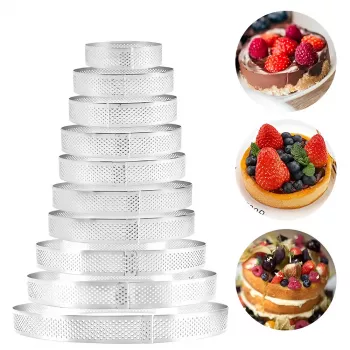
If the goal is a crisp shell with straight sides and a clean rim, a rigid perforated ring is a practical upgrade that doesn’t take up the cabinet space of bulky tart pans. The 304 Stainless Steel Perforated Tart Ring Mold – Heat-Resistant Pastry Tool is designed to support even baking around the crust and tidy release once cooled.
For bakers who like extra bottom heat, a heavy preheated surface can help with crispness. The Reversible Pre-Seasoned Cast Iron Griddle with Non-Stick Surface for BBQ and Cooking can also serve as a sturdy, heat-holding tool (when used safely within its intended temperature limits and your cookware guidance).
| Item | Details |
|---|---|
| Product | 304 Stainless Steel Perforated Tart Ring Mold – Heat-Resistant Pastry Tool |
| Material | 304 stainless steel |
| Design | Perforated tart ring (no fixed base) |
| Best for | Tart shells, pastry bases, crisp-edged bakes |
| Price | $7.51 USD |
| Availability | In stock |
Yes—because the ring has no base. Place it on parchment or a silicone mat on a flat sheet pan so the dough has a sealed bottom and the ring sits level.
The holes allow steam to escape and improve airflow around the crust, encouraging moisture to evaporate during baking and helping the shell crisp more evenly.
Let the shell cool completely so it firms up, then lift the ring straight up (or gently push the tart upward from below if supported) to avoid scraping the sides.








Leave a comment