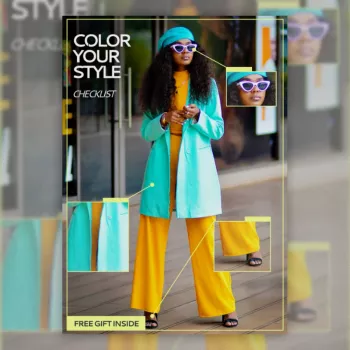
Keeping up with color trends doesn’t have to mean rebuilding a closet every season. A repeatable checklist makes it easier to spot what’s current, choose shades that flatter, and plan outfits that mix well with what’s already owned—whether shopping, packing, or getting dressed on busy mornings. For more guidance, see Popular Color Trends for Apparel.
Trend-smart color is a strategy, not a shopping spree. Instead of chasing every “it” shade, it focuses on updating a few key colors each season while keeping your reliable neutrals (like denim, black, cream, or navy) doing most of the heavy lifting.
Before adding any new shade, get clear on what already works. Your baseline is the color system you’re wearing on repeat—whether you call it “minimal,” “classic,” or “whatever was clean.”
| Checklist step | What to look for | Pass criteria |
|---|---|---|
| Neutral match | Pairs with core neutral bottoms/jackets | Works with 2+ neutrals |
| Outfit multiplier | Creates multiple outfit formulas | Builds 3+ outfits |
| Season fit | Comfort in current climate | Works with current layers/shoes |
| Care & wear | Laundry and lifestyle match | No “special care only” trap |
| Color comfort | Feels like “you” in photos and daylight | Would wear weekly |
Trends are easiest to use when you treat them like a signal, not a command. A fast way to filter noise is to look for repetition across sources and then translate that trend into your closet’s “language.”
If you want a quick reality check, tools like Adobe Color can help visualize harmonies (analogous, complementary, triad) before you buy.
A trend shade can be popular and still not be the best version for you. The goal isn’t to force a color—it’s to choose the variation that makes your skin look clearer and your eyes look brighter.
For extra context on how color forecasting works across industries, the Color Association of the United States (CAUS) is a helpful reference.
Color gets easy when you rely on repeatable outfit math. These formulas help a new shade look intentional right away.
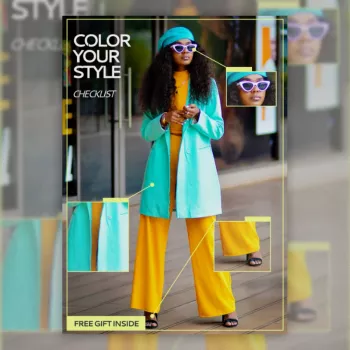
For a ready-to-use system, Color Your Style Checklist – digital download is built for quick decisions while shopping, styling, and planning outfits. It helps narrow trend noise into a wearable palette you can actually mix and repeat across your week.
If you’re also doing outfit photo tests (or just want to look more refreshed on busy mornings), the Ice Roller for Face & Eyes – Skin Tightening Facial Massage Tool can be a simple add-on to your routine—especially when you’re comparing how colors look in daylight and on camera.
Usually 1–2 trending colors plus one supporting shade is enough. A smaller palette increases outfit combinations and makes it easier to avoid impulse buys that don’t match anything.
Try a warmer/cooler version or a lighter/deeper version of the same color family. If it still feels off, wear it farther from your face (shoes, bag) or choose a print that includes the shade more softly.
Start with a neutral base, keep saturation levels similar, and repeat one color twice in the outfit (top and accessory, for example). Add a “bridge” piece like denim, cream, gray, or taupe to connect warm and cool tones.









Leave a comment